In John Cleland’s 1748 Fanny Hill: Memoirs of a Woman of Pleasure, morality is not necessarily something a person is born understanding. Instead, it is something shaped through experience and environmental exploration. Fanny, an orphaned young woman who leaves her childhood home for London, enters a world in which her understanding of sexuality, relationships and personal virtue is continually challenged. Her story offers an interesting perspective on the 18th-century philosophical debate surrounding sensibility – is morality an inherent human quality or something developed through personal exposures?
At the beginning of the novel, Fanny is largely unfamiliar with the realities of adult society. Her departure from the countryside and arrival in London mark a transition from an environment associated with innocence and nature to one defined by economic necessity and social expectations. Without the guidance of her parents or the security of her familiar home, she must learn to navigate unfamiliar circumstances. Her experiences, especially the sexual ones, become the foundation through which she develops her own understanding of right and wrong.
This characterization reflects the idea of innocence as a blank slate, which became particularly relevant to Enlightenment discussions of human nature. Rather than suggesting that individuals possess a complete understanding of morality from birth, this perspective emphasizes the influence of external experiences. Fanny’s development is, therefore, not simply a story of innocence lost, but an exploration of how individuals are shaped by the conditions in which they live.
In his literary criticism, Varieties of Eighteenth-Century Sensibility, Northrop Frye offers a useful framework for understanding the conventions through which readers interpret literature. In his discussion of literary craftsmanship, he writes, “Such craftsmanship works within a convention: it is the responsibility of a cultivated public to understand and respond to the subtleties in the convention, to hear all the harsh clustered consonants… but whenever literature or any other art is improving, it is moving toward a dead end. What has been done to perfection has been done” (6). His analysis encourages readers to consider not only what a literary work depicts, but also the conventions and expectations through which the audience understands it.
This distinction is particularly important when examining Fanny Hill. Although the novel’s explicit subject matter made it controversial, its narrative is more complicated than a straightforward celebration of sexual indulgence. Fanny recounts experiences that are frequently shaped by financial dependence and result as the decisions of those around her. The reader is consequently placed in the position of evaluating her circumstances rather than simply assigning her a moral label based on uncontextualized choices. Her story challenges the assumption that a woman’s sexual experiences alone can determine her virtue; According to Frye, Fanny is an example of moral behavior without blame, regardless of how the audience reacts to her story.
Frye’s discussion of pastoral literature also offers an interesting way to consider the novel’s movement between rural and urban environments. The countryside is traditionally associated with simplicity and innocence, while the city represents complexity, commerce and social corruption. However, these settings do not function in inherent opposition. Fanny’s experiences in London reveal the economic and social realities that are often concealed by idealized depictions of rural life.
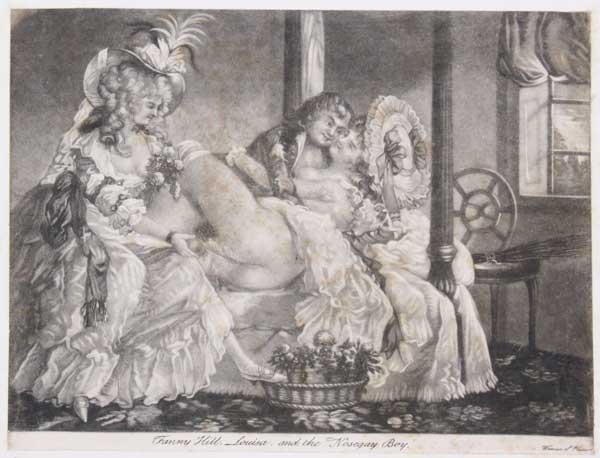
Visual representations of Fanny Hill further complicate the novel’s relationship with morality. A threesome illustration of a scene from the novel, illustrated in 1790, depicts a sexual encounter that would have been considered scandalous by the standards of 18th-century feminine propriety. Rather than presenting female sexuality as something inherently shameful, the illustration makes it an explicit part of Fanny’s narrative. Its inclusion invites readers to consider the tension between the period’s expectations of female modesty and the novel’s frank portrayal of women’s sexual experiences. The contrast is particularly striking when considered alongside the expectation that women remain virtuous and restrained, even as male sexual behavior was often treated with greater leniency.
The novel ultimately complicates the relationship between personal virtue and public judgement. Fanny’s identity is shaped by experiences she does not always control, yet she remains the narrator of her own story. In this sense, Fanny Hill raises a question that extends beyond its historical setting: if morality is influenced by circumstance, who has the authority to decide whether another person’s choices are virtuous?
Understanding Fanny as a product of her environment rather than a fixed moral category provides a different perspective on the novel. It also establishes an important foundation for considering how expectations surrounding women’s sexuality have evolved, and which assumptions have remained remarkably familiar. More on this topic can be explored here.


Leave a Reply